Sunday, April 2, 2017

Story Functions in Facebook Family

Chan Nga Yan, 1155081733

 After cloning the Snapchat's popular story function on its most youth-liked app - Instagram, Facebook announced that Whatsapp would also launch a similar function to replace userstext statuses in Feb. The new version allowed users to update photos, GIFs or videos overlaid with drawings, emojis or caption on their status which will be only visible to their selected friends for 24 hours before vanishing. However, after receiving a series of negative responsesWhatsApp has decided to take the new function off the table, and now it will only be available alongside the original text statuses.  


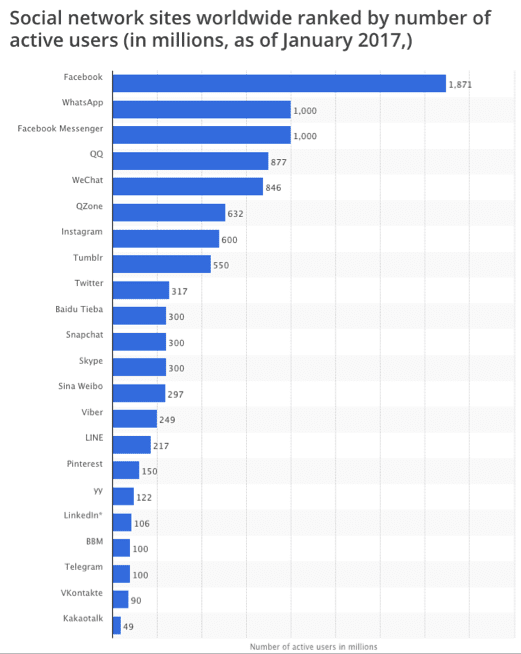
The major reason that Facebook is try so hard to cover Snapchat’s most successful feature in all its family apps is probably it sees Snapchat will become its biggest threat in the near future. According the statistic as of January 2017, Facebook is ranking number 1 as the most popular social network site worldwide with 1.87 billion monthly active users, followed by WhatsApp, Facebook Messenger on second and third, Instagram on sixed. Snapchat is ranking on the eleventh place with 300 million active users. (statista, 2017) It seems there is still a big difference between the size of Facebook and Snapchat’s user base.

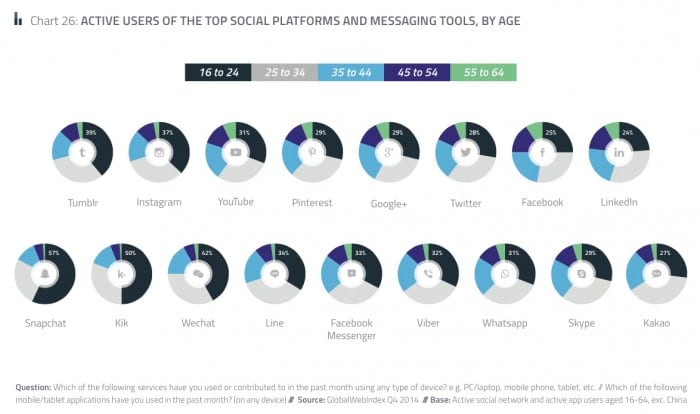
However, if we take a look into the demographic of the active users of these top social platforms, we can see where Facebook’s worries came from. Only 25% of Facebook users are between 16 and 24 years old, while 37% for Instagram and 57% for Snapchat. Facebook’s aging problem could lead to fade out in the future. Therefore, it needs to take back the youth market by modifying its features.


Few days ago, Facebook has announced that the story function will also be added in the Facebook app which will consist more AR facemask filters, stickers, emoji and drawing functions, in order to encourage users to share more regularly with more instant content.  

Facebook is phrase-by-phrase examining the possibility of adapting the story function in all its family apps, with the ultimate goal of eliminating SnapChat from the social media market. It first started from Instagram which targets at similar young user group as snapchat, then to the more general-used Whatsapp and Facebook Messenger, and finally to the main revenue generator – Facebook. Every phrase was harder than the previous one, as the average age of the users is higher and it would be harder to persuade them to accept new functions.  What's next, we need to wait and see if Facebook is able to change its existing users' behaviors or vice versa.  

Reference:
Most famous social network sites worldwide as of January 2017, ranked by number of active users (in millions). (2017). Retrieved from https://www.statista.com/statistics/272014/global-social-networks-ranked-by-number-of-users


Wednesday, March 29, 2017

How the Cultural and Creative Industries in Domestic Museums Receive a Contemporary Revive?

Luo Zhaohui (1155084240)


Inspired by architect Ieoh Ming Pei, a unique shape of the wooden seat has finally launched in the Taobao store of Suzhou Museum. The product was created by Suzhou Museum and independent designers, and then promoted by Taobao crowdfunding.

Converting static artifacts into popular designs, has become a trend of cultural and creative industries in domestic museums, but this was developed in the last two or three years. Regarded as a tourist souvenirs, the cultural and creative industries were not taken seriously in the past decades.


Dismal Past

Many people may have such an experience when visiting the the Forbidden City: the most popular items in the shop are instant noodles or beverage, souvenirs are lack of texture like Yiwu commodity, or too high to be afforded like cultural relic. 

The dismal business of cultural and creative industries are lead by the system to a large extent. As a public institution, the museum's operating funds are depend on financial support, then all income in the musemu should be paid. Over time, no one is willing to studying cultural and creative industries.


While under the background of "New Museology movement" in the 1980s, museums in Europe and America opened the historical tide of the revolution. Cultural relics are no longer the center of museums, instead, they began to emphasize the feelings of visitors. For example, Paris Le Louvre Museum opened up the underground shopping malls, converting the museum into a public space of art and commerce.

With many museums open for free, designing art derivatives has become a common mode of operation. British Museum has cooperated with many manufacturers, forming a complete set of mature industries from design, manufacturing to marketing. For example, when you search “Rosetta Stone(罗塞塔石碑)”on the official website, there will be more than 60 kinds of derivatives covering a variety of price and types.

The New York Museum of modern art (MoMA), on the other side of the ocean, has built a souvenir shop into a brand of design and art. Although it would take Van Gogh's "Star" printed on the umbrella and mugs, MoMA souvenir shop looks more like a fashion buyers shop, you can get many cross-border products here such as the stationery designed by Chanel Karl Lagerfeld, or the vase designed by Japan's famous porcelain masters Komatsu Cheng.

Change from the Forbidden City

A scotch tape called “朕知道了” in Taipei Palace Museum began to explode on social network in 2013. The inspiration of “朕知道了” can traced back to a Zhupi memorials exhibition (朱批奏折展) in 2005. It is this special scotch tape inadvertently witnessed the beginning of an era.

“朕知道了”made the Forbidden City really aware of the huge market of cultural and creative industry. In the same year, the Forbidden City began to roll out a wave of creative products, the popular weibo and wechat public account “故宫淘宝” also entered into the public view that time. 


In the next few years, the 600-year-old Forbidden City began to become youth in an unprecedented gesture along with the Internet. People began to exclame that the past solemn palace has become“萌萌哒”, the products like “朝珠耳机”,“奉旨旅行”luggage tag, and “朕就是这样汉子”folding fan were in favour. 

The new look presented by the Forbidden City are much more from the details of the changes in the stack. Essentially, all changes can be derived from its selt-location: it starts from the viewpoint of the market, aiming to improve the audience experience and enhance the brand value of the museumas well as the way of cultural communication.

New inspirations

Driven by the Forbidden City, more and more domestic museums began to launch the cultural and creative industries. Also, there are external cooperation in most of the museums, the combination of social media and e-commerce become a marketing standard for most of the museums.

For example, the National Museum opened a Tmall flagship store last year, launching its own brand “国博衍艺”as well as the weibo account of the same brand. Also, Suzhou Museum and 聚划算 jointly held a cross-border fashion show based on the theme of "Walking History". 

While developing a really cultural connotation and well-recognized product is not easy. From the current situation, the domestic museum is still at the primary stage: although the number of cultural and creative museum has benn increased, the quality is not satisfactory. Many products are just to simply copy the elements of cultural relics, or malicious or simply do not adorable and practical.

Like British Museum cultural and creative development director John Robert said, "we follow the principles of avoiding the cheap consumer texture lead by the fashion design. 

Limited by talent, ability and capital, many domestic museums and cultural development still need a long way to go. When the opportunity comes, the challenge has just begun. 

Special Train with Music Reviews: Seeing the Power of Music – An Integrated Marketing Campaign of Netease Cloud Music

April, XU Xin, 1155089254

On March 20, a special train in red color, decorated with a large collection of touching music reviews at Hangzhou subway station caught thousands of passersby’ attention, instantly becoming a hit in social networks. It’s a marketing campaign called seeing the power of music conducted by Netease Cloud Music, which contracted ads of line 1 as well as Jiangling Road Station with high-quality music reviews selected from the platform.
Figure 1. Photos of the Campaign.

However, it’s not uncommon to advertise on subway, and there are several successful precedents, from Headline Today, Particle News to recent Peach Blossom Train implemented by a popular TV drama. Nevertheless, what makes this campaign outstanding is that it doesn’t promote through size and quantity of ads or empathizing slogan, but from a product perspective, and importantly, it widely spreads on the internet, leading to a mania of sharing and discussing on social media.

With no doubt, multiple highlights are presented from this campaign. Firstly, it’s the sensitive insights of user psychology and the choice of advertising place. Apparently, subway is a common transport carrying people together with their hopes and dreams, also loneliness on the struggling way. Because of confined space, it’s easier for people to concentrate, think and to recall the past. Thus, people will be easily struck if the ad copy shares the same emotion.

Besides, empathetic music reviews is another highlight of this campaign. Specially, music reviews is one of unique features of Netease Cloud Music. It’s said that approximately 640,000 reviews are produced by users everyday and over 400,000,000 reviews are stimulated on the app up to now. Just like seeing shoots on video websites, looking through music reviews to find comforts has become a habit for majority of users. Focused on this, the marketing team selected top hot 5000 pieces of reviews through computer and according to its specific content, they picked up 85 reviews which are simple but touching, understandable and empathetic, covering the popular topics of dream, life, friendship and love. And taking them as advertisements in the combination of review, user ID and song, which reflects the feature of product and matches the brand position – a warmhearted music society.

For example, @Culiu writes that I want to be the one who describe you at your funeral, after listening to the song Palpitation. Thank you for accompanying me from wearing school uniform to wedding dress, which is written by @Nanguobeidao below the song Duandian of Hins Cheung. And @Ney_S writes the review under the song Long Lost Pen Pal that when I was young, I hoped to be everyone except myself.
Figure 2. Music Reviews of the Campaign.
More reviews can be seen from the last link of references.

It’s admitted that user generated content and real people stories can bring audience unexpected surprise with touching power. When people see these reviews, they feel like talking to an ordinary person about his simple but unforgettable stories rather than a speech with high-sounding words. In this equal way, people may find some same experience and resonate with what they say. And then, they probably become interested in the song that brings such feelings, download the app, enjoy the song and find some like-minded people. Just as the vice president of Netease Cloud Music, Li Yin, said that they applied the product strategy to do social marketing and provided what users what to know, digging out content and guiding users to share same emotions, instead of traditional one-way information delivery of brand.

For this campaign, the biggest success is the transformation from offline to online, creating secondary spread on the internet. People who came across this campaign took pictures of these reviews, posted on the social media and wrote down their opinions and feelings. In addition to these personal content sharing from experiencer, official media platforms like Wechat subscription and other media or KOL reported this activity, which attracted plenty of people share and express a deep sense of identity on social media.
Figure 3. Screenshots of official media platform posts.

Consequently, the campaign report on Wechat subscription has been viewed more than 100,000, which was 5 times the number of reading in normal times. Several songs related to splendid reviews ranked high on the music list and Netease Cloud Music has gone straight to number one in the music category of app store.
Figure 4. Ranking trend of Netease Cloud Music's Download.

In a word, the campaign of Netease Cloud Music build emotional similarity with public through presenting user generated music reviews and successfully transform to online marketing by widely sharing and discussion, attracting people download the app and experience the music society. The logic of this marketing campaign can be concluded in the picture as below.
Figure 5. Logic of this Marketing Campaign.

Obviously, through this activity, Netease Cloud Music completed the objective to increase the brand awareness and attract potential users, showing the unique distinction from other music app – a music society with emotions from a product perspective.

References:
网易云音乐是如何用产品思路做营销的?http://www.managershare.com/post/328167
用评论击碎万颗心,这是网易云音乐独享的胜利 | 营销观察http://36kr.com/p/5067823.html
那些让人拍案叫绝的网易云音乐神评论(最全版本)http://mt.sohu.com/20170325/n484759361.shtml